Tell us about the job
Takes about a minute. No obligation.
A central AC compressor in Bennington County runs almost nothing, and a system that never gets tested by actual demand will hide a wiring fault, a refrigerant undercharge, or a contactor problem until the one afternoon a homeowner turns it on. Homes in Bennington County, VT have essentially no cooling season — no month of the year is warm enough to call for it. Contractors sizing and commissioning a new system here are not working around accumulated wear on cycling parts. They are working around the opposite: equipment that will sit dormant and then be asked to perform without warning. A poor install gets no chance to reveal itself gradually, so the load calculation, the refrigerant charge, and the electrical connections have to be right from the first day.
Ductwork sized and routed for an old furnace does not automatically carry a new central AC system. A contractor installing here has to walk the existing runs, check where they go and how they branch, and judge whether the layout will distribute conditioned air the way a cooling system needs it to. Half the homes in Bennington County, Vermont were built in 1972 or earlier (2020-2024 ACS 5-year). That means the duct assessment shapes both the equipment selection and the electrical work that follows, because a system matched to what the house actually has will perform differently from one specified on paper alone.
What a Central AC Installation Puts in Your Home
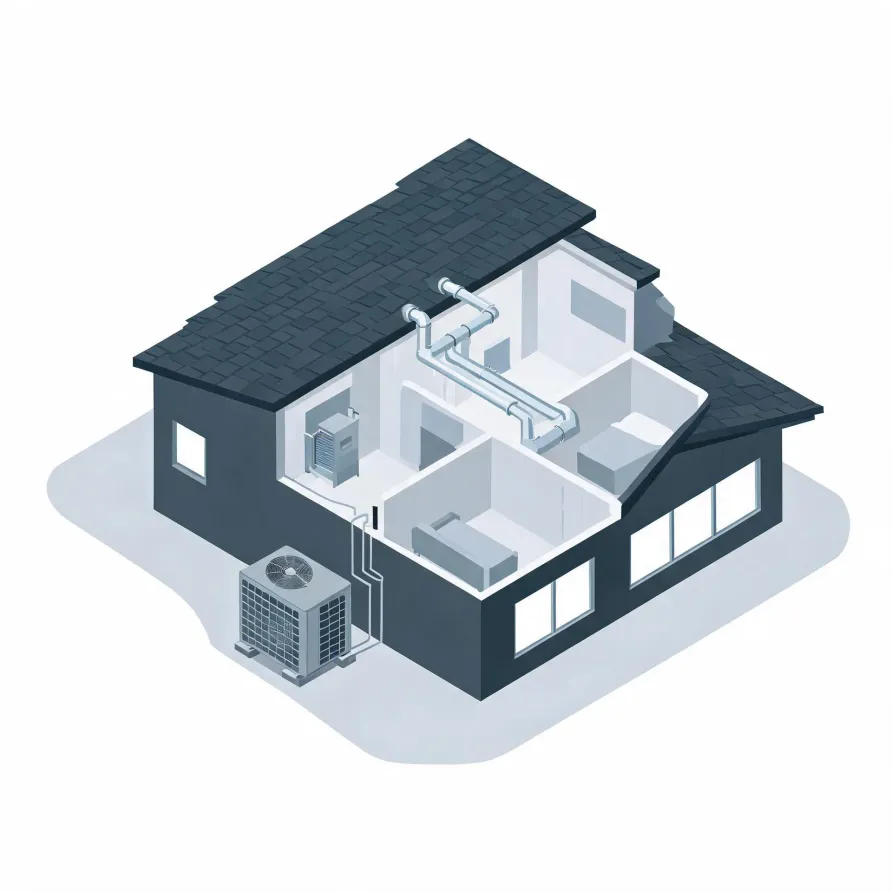
The outdoor condenser unit sits on a pad beside the house and holds the compressor and condenser coil, the parts that shed heat to the outside air. Inside, the air handler or furnace-mounted evaporator coil sits where the forced-air system already lives, pulling warmth out of the air that passes through it.
A refrigerant line set runs between the two units, carrying the refrigerant that makes the exchange work, and a condensate drain line runs from the indoor coil to a suitable drain point to carry away the moisture that collects during operation.
The drawing shows a typical layout, and a licensed contractor determines what the installation looks like for your specific house.
Find a contractor in Bennington CountyBennington County, by the numbers
165 severe weather events were recorded in Bennington County, Vermont between 2015 and 2024.
NOAA National Centers for Environmental Information, Storm Events Database, bulk CSV export, events 2015-01-01 through 2024-12-31.Half the homes in Bennington County, Vermont were built in 1972 or earlier (2020-2024 ACS 5-year).
U.S. Census Bureau, 2020-2024 American Community Survey 5-Year EstimatesBennington County, Vermont holds 20,903 housing units (2020-2024 ACS 5-year).
U.S. Census Bureau, 2020-2024 American Community Survey 5-Year EstimatesOwners occupy 73.7% of the occupied homes in Bennington County, Vermont (2020-2024 ACS 5-year).
U.S. Census Bureau, 2020-2024 American Community Survey 5-Year EstimatesCodes & Standards Governing Central AC Work in Bennington County, Vermont10 sourced rules and standards
What the installation actually looks like
Split-system central air conditioners rated below 45,000 Btu/h manufactured on or after January 1, 2023 must meet a federal minimum of 13.4 SEER2.
Split-system central air conditioners rated at or above 45,000 Btu/h manufactured on or after January 1, 2023 must meet a federal minimum of 13.4 SEER2.
Split-system central air conditioners manufactured between January 1, 2015 and December 31, 2022 had to meet 13 SEER, the metric that preceded SEER2.
Single-package central air conditioners manufactured on or after January 1, 2023 must meet a federal minimum of 13.4 SEER2.
Space-constrained central air conditioners manufactured on or after January 1, 2023 must meet a federal minimum of 11.7 SEER2.
Federal efficiency standards for split-system central air conditioners and heat pumps are set on each certified combination of outdoor unit and indoor coil rather than on the outdoor unit alone.
Residential and light commercial air conditioning and heat pump systems assembled in the field, including mini-splits and unitary systems, may not be installed on or after January 1, 2025 using a refrigerant with a global warming potential above 700.
A field-assembled system whose specified components were all manufactured or imported before January 1, 2025 carries no installation compliance date under the refrigerant restrictions and may still be installed.
Licensing and Legal Requirements in Bennington County, Vermont
Vermont splits the trade across two specialty licences and a contractor may hold one without the other: field A1 covers automatic gas or oil heating including geo-thermal and ground source heat pumps, and field C3 covers refrigeration or air conditioning including air-to-air heat pumps.
Vermont reaches HVAC work through its electricians’ licence rather than an HVAC licence, and the requirement stops at the front door of a house: anyone performing electrical work in Vermont must be licensed as an electrician unless the work is in a residential building containing two or fewer dwelling units.
Severe Weather Events in Bennington County, Year by Year
Weather shapes how hard HVAC equipment has to work and how long it lasts. What hits Bennington County hits the systems installed here, which is why local weather history is part of understanding what central air installation means for this area.
165 severe weather events, 2015–2024. Source: NOAA National Centers for Environmental Information, Storm Events Database.