Tell us about the job
Takes about a minute. No obligation.
A compressor that has stood off since last July carries its own failure risk into the next season. Seals dry, contactors corrode, and refrigerant leaks that would have shown up during regular cycling go unnoticed until the unit is asked to start. Homes in Grand Isle County, VT run cooling in a single month of the year, July. A contractor diagnosing a repair here checks starting components and electrical contacts before anything else, because those are the parts that bear the full stress of a cold start after a long idle.
Ductwork in much of this county was laid for cooling from the start, so when a repair call comes in, the contractor goes straight to the equipment. Half the homes in Grand Isle County, Vermont were built in 1984 or earlier (2020-2024 ACS 5-year). That is enough time for contactors to pit, capacitors to weaken, and refrigerant circuits to develop slow leaks at fittings that have been heating and cooling through hundreds of seasons. What the opened unit contains determines the bill: a failed run capacitor is a short visit, while a compressor with burnt windings is a different conversation entirely.
The Parts of a Central AC a Contractor Checks First
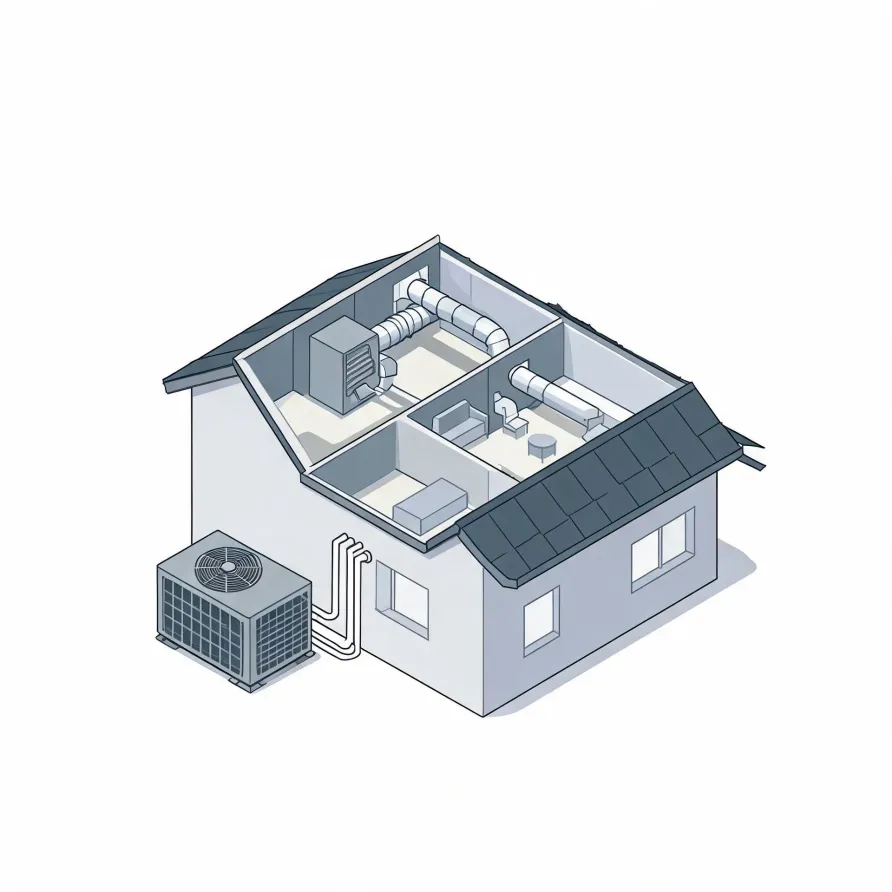
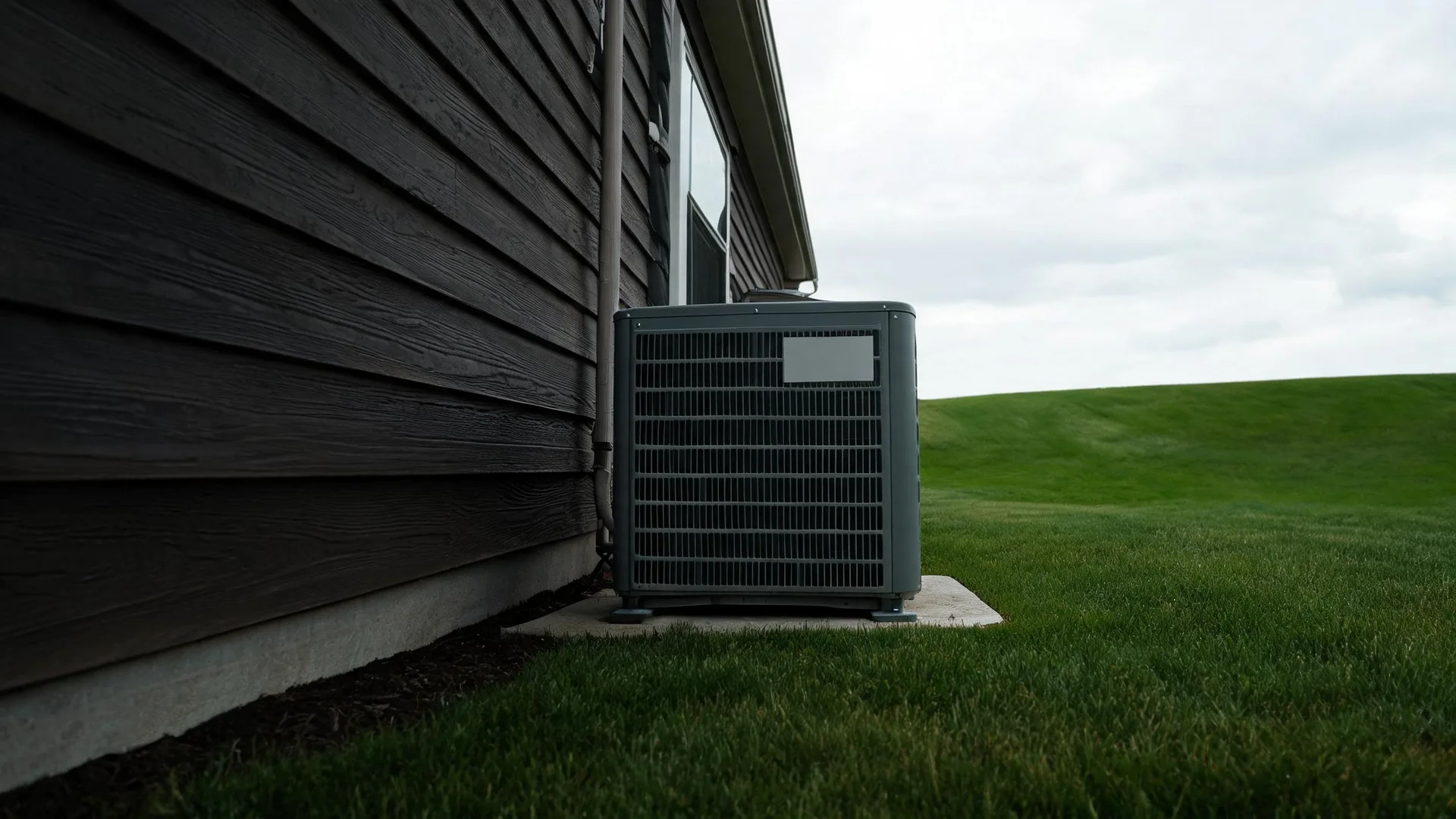
The outdoor condenser unit sits outside the house, usually on a pad beside the foundation, and it carries the compressor and the condenser coil. These are where a contractor starts when the system stops cooling, runs but produces warm air, or short-cycles. A failed compressor, a refrigerant leak at the coil, or a seized condenser fan motor are the problems most likely to bring a contractor to that cabinet.
Inside the house, the air handler holds the evaporator coil and the blower that moves air across it. A frozen evaporator coil, a failing blower motor, or a clogged drain line each show up here. The thermostat and the refrigerant lines connecting the two units also factor into a diagnosis when the system behaves erratically or loses cooling capacity without an obvious cause at either unit.
The drawing shows the general layout of a central AC system, and a licensed contractor determines which components apply and what work is needed in your specific home.
Find a contractor in Grand Isle CountyGrand Isle County, by the numbers
53 severe weather events were recorded in Grand Isle County, Vermont between 2015 and 2024.
NOAA National Centers for Environmental Information, Storm Events Database, bulk CSV export, events 2015-01-01 through 2024-12-31.Half the homes in Grand Isle County, Vermont were built in 1984 or earlier (2020-2024 ACS 5-year).
U.S. Census Bureau, 2020-2024 American Community Survey 5-Year EstimatesGrand Isle County, Vermont holds 5,326 housing units (2020-2024 ACS 5-year).
U.S. Census Bureau, 2020-2024 American Community Survey 5-Year EstimatesOwners occupy 89.9% of the occupied homes in Grand Isle County, Vermont (2020-2024 ACS 5-year).
U.S. Census Bureau, 2020-2024 American Community Survey 5-Year EstimatesCodes & Standards Governing Central AC Repair in Grand Isle County, Vermont10 sourced rules and standards
What HVAC Repair Looks Like in Grand Isle County
Split-system central air conditioners rated below 45,000 Btu/h manufactured on or after January 1, 2023 must meet a federal minimum of 13.4 SEER2.
Split-system central air conditioners rated at or above 45,000 Btu/h manufactured on or after January 1, 2023 must meet a federal minimum of 13.4 SEER2.
Split-system central air conditioners manufactured between January 1, 2015 and December 31, 2022 had to meet 13 SEER, the metric that preceded SEER2.
Single-package central air conditioners manufactured on or after January 1, 2023 must meet a federal minimum of 13.4 SEER2.
Space-constrained central air conditioners manufactured on or after January 1, 2023 must meet a federal minimum of 11.7 SEER2.
Federal efficiency standards for split-system central air conditioners and heat pumps are set on each certified combination of outdoor unit and indoor coil rather than on the outdoor unit alone.
Residential and light commercial air conditioning and heat pump systems assembled in the field, including mini-splits and unitary systems, may not be installed on or after January 1, 2025 using a refrigerant with a global warming potential above 700.
A field-assembled system whose specified components were all manufactured or imported before January 1, 2025 carries no installation compliance date under the refrigerant restrictions and may still be installed.
Licensing and Legal Requirements in Grand Isle County, Vermont
Vermont splits the trade across two specialty licences and a contractor may hold one without the other: field A1 covers automatic gas or oil heating including geo-thermal and ground source heat pumps, and field C3 covers refrigeration or air conditioning including air-to-air heat pumps.
Vermont reaches HVAC work through its electricians’ licence rather than an HVAC licence, and the requirement stops at the front door of a house: anyone performing electrical work in Vermont must be licensed as an electrician unless the work is in a residential building containing two or fewer dwelling units.
Severe Weather Events in Grand Isle County, Year by Year
Storm activity puts real stress on central AC systems, from power fluctuations that damage compressors to temperature swings that push equipment hard after an outage. How often that stress hits depends on where you are, and Grand Isle County has its own weather history.
53 severe weather events, 2015–2024. Source: NOAA National Centers for Environmental Information, Storm Events Database.