Tell us about the job
Takes about a minute. No obligation.

A contractor quoting a central AC repair in Windsor County has to rule out age and dormancy before blaming anything else. Homes in Windsor County, VT have essentially no cooling season — no month of the year is warm enough to call for it. Compressors that sit idle season after season develop their own failure modes: seals dry, contacts corrode, and refrigerant migrates when the system goes unrun for long stretches. The first hot day of any given summer is when those faults surface, and it is also when every other homeowner calls. A contractor who opens the unit is looking at accumulated stagnation, not accumulated runtime.
Half the homes in Windsor County, Vermont were built in 1973 or earlier (2020-2024 ACS 5-year). When a technician opens a central AC unit in a house this old, the first question is whether the failed component is still manufactured, and the answer depends entirely on what brand and configuration is inside. Some of that equipment has had parts discontinued. Others are still supported. A contractor has to identify the exact assembly before any order is placed, which is why repair visits here rarely follow a predictable scope until the unit is open.
The Parts of a Central AC a Contractor Checks First
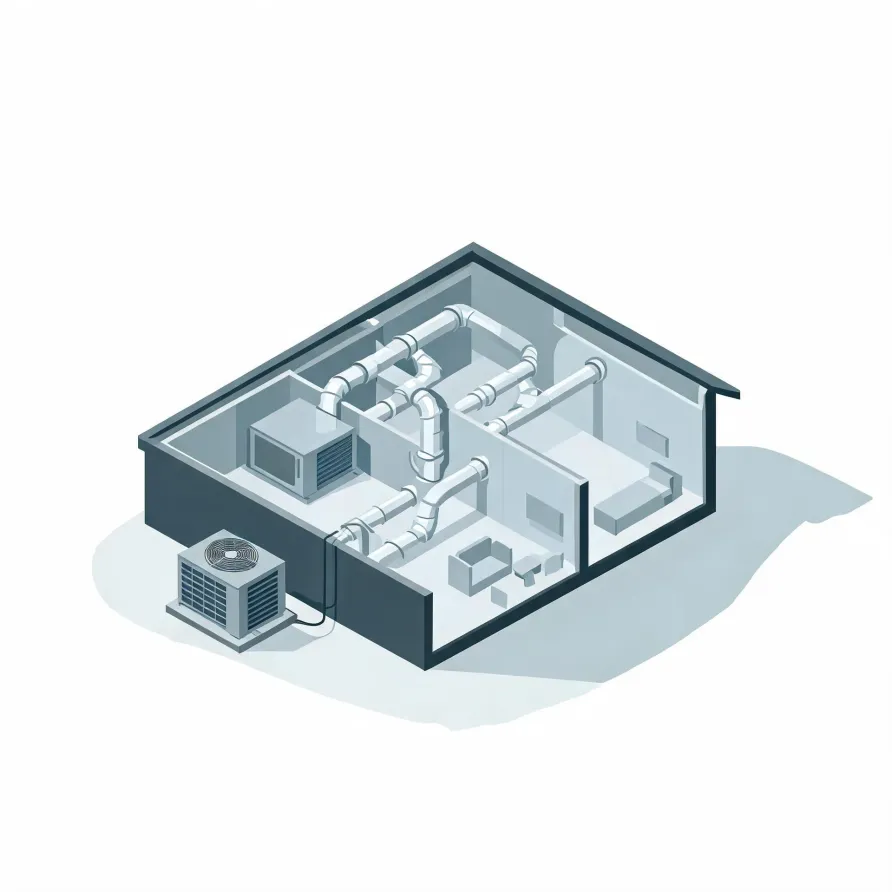
The outdoor condenser unit sits outside the house, usually on a concrete pad beside the foundation, and it holds the compressor and condenser coil. These are the parts a contractor goes to first when the system stops cooling, because a failed compressor or a dirty, damaged coil is often what has gone wrong.
Inside the house, the air handler or furnace cabinet holds the evaporator coil and the blower. The evaporator coil is a frequent source of problems, whether from ice buildup or refrigerant loss, and the blower motor gets checked when airflow is weak or uneven. The expansion valve and refrigerant lines connect the two units and come into the picture when the system runs but the air stays warm.
The drawing shows the typical layout of a central AC system, and a licensed contractor determines which components need attention in your specific home.
Find a contractor in Windsor CountyWindsor County, by the numbers
96 severe weather events were recorded in Windsor County, Vermont between 2015 and 2024.
NOAA National Centers for Environmental Information, Storm Events Database, bulk CSV export, events 2015-01-01 through 2024-12-31.Half the homes in Windsor County, Vermont were built in 1973 or earlier (2020-2024 ACS 5-year).
U.S. Census Bureau, 2020-2024 American Community Survey 5-Year EstimatesWindsor County, Vermont holds 34,846 housing units (2020-2024 ACS 5-year).
U.S. Census Bureau, 2020-2024 American Community Survey 5-Year EstimatesOwners occupy 74.8% of the occupied homes in Windsor County, Vermont (2020-2024 ACS 5-year).
U.S. Census Bureau, 2020-2024 American Community Survey 5-Year EstimatesRules & Standards Governing Central AC Repair in Windsor County, Vermont10 sourced rules and standards
What Happens When a Contractor Comes Out
Split-system central air conditioners rated below 45,000 Btu/h manufactured on or after January 1, 2023 must meet a federal minimum of 13.4 SEER2.
Split-system central air conditioners rated at or above 45,000 Btu/h manufactured on or after January 1, 2023 must meet a federal minimum of 13.4 SEER2.
Split-system central air conditioners manufactured between January 1, 2015 and December 31, 2022 had to meet 13 SEER, the metric that preceded SEER2.
Single-package central air conditioners manufactured on or after January 1, 2023 must meet a federal minimum of 13.4 SEER2.
Space-constrained central air conditioners manufactured on or after January 1, 2023 must meet a federal minimum of 11.7 SEER2.
Federal efficiency standards for split-system central air conditioners and heat pumps are set on each certified combination of outdoor unit and indoor coil rather than on the outdoor unit alone.
Residential and light commercial air conditioning and heat pump systems assembled in the field, including mini-splits and unitary systems, may not be installed on or after January 1, 2025 using a refrigerant with a global warming potential above 700.
A field-assembled system whose specified components were all manufactured or imported before January 1, 2025 carries no installation compliance date under the refrigerant restrictions and may still be installed.
Licensing and Legal Requirements in Windsor County, Vermont
Vermont splits the trade across two specialty licences and a contractor may hold one without the other: field A1 covers automatic gas or oil heating including geo-thermal and ground source heat pumps, and field C3 covers refrigeration or air conditioning including air-to-air heat pumps.
Vermont reaches HVAC work through its electricians’ licence rather than an HVAC licence, and the requirement stops at the front door of a house: anyone performing electrical work in Vermont must be licensed as an electrician unless the work is in a residential building containing two or fewer dwelling units.
Severe Weather Events in Windsor County
Weather puts load on central AC equipment. Hard seasons accelerate wear, push systems to run longer, and drive the repair calls that define how much work local contractors handle.
96 severe weather events, 2015–2024. Source: NOAA National Centers for Environmental Information, Storm Events Database.