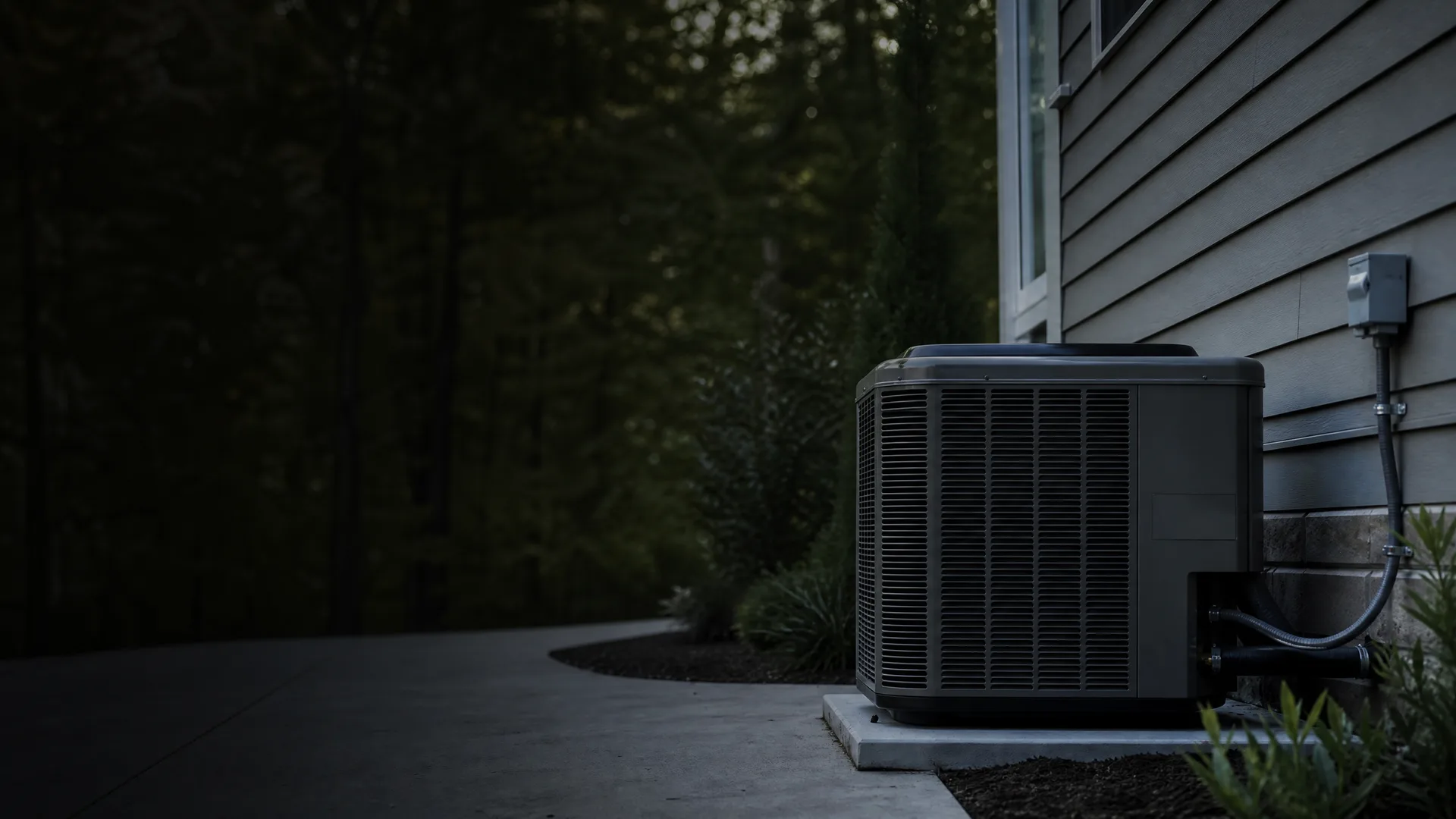
An outdoor air conditioning condenser unit on a concrete pad beside a house with horizontal siding, with an electrical disconnect box on the wall and shrubs to the right in low evening light.

Matched to your air conditioner job

Why your AC compressor won't kick on in Vermont

Your thermostat calls for cold air and nothing happens. The outdoor unit sits quiet, no hum, no click. That can be the capacitor, the contactor, a tripped breaker, or something in the compressor itself, and with summers here short, you don't want it sitting dead for long. This page walks through what stops a compressor from starting and what to check before it gets worse. Send in your details and a contractor who works on Vermont systems will follow up with you.

Find my pro

When the compressor won't start, the problem is usually one part keeping it from getting power, not the compressor itself. A capacitor gives the compressor its starting push, and a weak one leaves the unit humming or silent. A bad contactor means the switch that sends power out to the unit never closes, so the indoor thermostat can call for cold air all it wants and nothing happens outside. A tripped breaker does the same thing from a different direction. The compressor can also trip its own internal overload if it's been struggling for a while, which shuts it down to protect it. Vermont summers are short, and a unit that won't start on a warm week in July or August is losing you the mild stretch you get this air for. None of these are something to test by waiting a few more days to see if it starts on its own.

A gray outdoor air conditioner condenser unit on a concrete pad beside a house with horizontal lap siding, with a wall-mounted disconnect box and conduit at left and a green shrub and mulch bed at right.
A disconnect box feeds power down to the condenser without any trip or interruption along the way.
An outdoor air conditioner condenser unit on a concrete pad beside a house with horizontal lap siding, with a conduit running to a gray electrical disconnect box on the wall.
Here the breaker or the contactor has cut power before it reaches the compressor at all.

A contactor is just a switch. A magnetic coil pulls its contacts shut every time your thermostat calls for cooling, and those contacts send power down to the compressor and outdoor fan. Every time they close, there's a small arc, and over years that arc pits the metal. Eventually the coil still pulls, you can sometimes hear it click, but no power gets through and the unit sits silent.

A bad capacitor sounds different. Instead of nothing, you get a hum. The compressor tries to start, can't get the push it needs, and shuts itself down. If your outdoor unit has a hard start kit wired into the compressor circuit, a failure there can cause the same struggle even with a capacitor that still tests fine.

There's also an overload switch built into the compressor itself. It opens when the compressor draws too much current, which can make a bad contactor or a weak capacitor look like a dead compressor when the compressor was never the problem.

Contactor, Capacitor, or Compressor

  • A contactor is a small switch with two contacts that get pulled together by a magnetic coil every time the thermostat calls for cooling.
  • Those contacts carry the full load to the compressor and outdoor fan, and years of arcing each time they close can pit or burn them.
  • Once the contacts are burned enough, the coil can still pull them together but no current gets through, so the unit stays silent.
  • A failing capacitor shows up differently: the compressor may hum for a second trying to start, then shut down on its own protection.
  • Some outdoor units have a hard start kit added to the compressor circuit, and if that fails, the compressor can struggle to start even with a good capacitor.
  • The compressor itself has an internal overload switch that opens if it draws too much current, which can make a bad part elsewhere look like a dead compressor.
A woman with dark hair in a bun reclines on a sofa with her eyes closed, wrapped in a cream fleece blanket, a closed blue hardcover book resting in front of her, with a lit lamp and a vase of dried flowers in the background.
A smiling bearded man in a navy sweater sits at a candlelit dinner table with a glass of red wine, a bowl of salad, and plates of food in the foreground.

An air conditioner pro near you

Send the request today and stop worrying about who to call.

No fee to send it, and nothing to sign.

Short summers raise the stakes

Vermont doesn't give you a long cooling season to work with. If the compressor sits dead through a stretch of warm days in July, that's a real chunk of the few weeks you'd actually use the AC. A furnace problem in January can wait a day without much consequence. A dead compressor in August means the house stays warm through the only part of the year it was built to cool, and there's no getting those days back once the weather turns.


Power rates make the fix worth getting right

Electricity here runs higher than most of the country, and a compressor that's struggling to start, pulling hard against a weak capacitor or chattering on a pitted contactor, draws more than one that starts clean. That shows up on the bill even in the short stretch it runs. A unit that won't start at all costs nothing to run, but one that starts rough and keeps cycling that way is spending extra on every attempt, in a state where every kilowatt costs more.

An outdoor air conditioning condenser unit on a concrete pad beside a house with horizontal siding and a concrete foundation, with dry brown leaves on the ground to either side.
Before you get your air conditioner repair
A gray outdoor air conditioning condenser unit on a concrete pad beside a house with horizontal lap siding, with a wall-mounted disconnect box and conduit, and shrubs to the left.
After you get your air conditioner repair
An outdoor air conditioner condenser unit on a concrete pad beside a house with beige horizontal siding and a stone-veneer base, with refrigerant lines running to a gray wall-mounted electrical box, surrounded by dark mulch, a flowering shrub and an evergreen on the left.

Running normally

The compressor cycles on, the fan spins, and the unit settles into a steady hum. Air comes out cold at the registers within a few minutes. On a muggy July evening this is the whole job: the thermostat calls, the outdoor unit answers, and the house catches up.

An outdoor air conditioning condenser unit on a concrete pad beside a house with light vinyl siding, an electrical disconnect box and conduit on the wall, bare shrubs and mulch to the right, and a concrete walkway in the foreground.

Won't start

The outdoor unit sits dead at the disconnect box with no hum, no click, nothing turning. The thermostat is calling for cold air and the compressor isn't answering it. Left alone, this doesn't fix itself, and every warm day it sits idle is one you don't get back.

A smiling man in a dark navy sweater sits on a light sofa in a living room, with a glass bowl of popcorn on a wooden coffee table and bookshelves behind him.
A smiling man in a dark green sweater sits on a tan leather sofa in a dimly lit living room, with a bowl of popcorn in the foreground and a kitchen area blurred behind him.
A smiling middle-aged man in a dark shirt sits on a gray sofa in a living room, with a bowl of popcorn on a side table and shelves, a window and kitchen area behind him.
A smiling bearded man in a dark gray t-shirt sits on a gray couch in a living room, with a large glass bowl of popcorn on a wooden table in the foreground.

A dead compressor in July doesn't give you a second system to fall back on. Most houses here lean on oil for heat, and the air conditioner is the one thing standing between you and a shut window on a muggy night.

Power in Vermont costs more than almost anywhere else, so a compressor that short cycles or strains to start runs up a bill fast even while it struggles to cool the house down.

Power costs 22.79 cents per kilowatt-hour statewide

Vermont homes paid 22.79 cents per kilowatt-hour in 2025, among the highest rates in the country. A compressor that short-cycles or struggles to start pulls harder on that rate every time it tries. Getting the right part fixed, rather than just restarted, keeps your bill from climbing along with it.

EIA-861 2025 statewide residential average

A woman in a cream cardigan and jeans stands with one hand raised facing an open front door of a gray horizontal-siding house, with a black lantern wall light, a potted shrub with yellow flowers, and a stone-faced porch column.

A quiet outdoor unit has a reason, and it's usually fixable

A compressor that won't start almost always comes down to one part standing between it and power: a capacitor, a contactor, a breaker, or a connection that's failed somewhere along the line. Finding which one it is takes someone who can test the unit rather than guess at it, and that's the difference between a five-minute fix and a unit that keeps failing you.

You don't have to figure out which part it is yourself. Once you send in what's going on, matching you with a contractor who knows these systems becomes someone else's job, not yours. They'll reach out and take it from there, so the rest of your summer isn't spent wondering if tonight's the night the AC decides to work.

A living room corner with a light beige sofa holding a textured taupe cushion, a large ceramic vase of olive branches by a window, a framed neutral artwork on the wall, and a dark bowl with stacked books in the foreground.
An outdoor air conditioner condenser unit sits on a concrete pad beside a house with horizontal lap siding, with a refrigerant line, electrical disconnect box, a concrete driveway and dark trees in the background.

A local pro for your air conditioner repair

Send the request and finding a pro stops being your problem.

Step 1 of 3: Equipment