
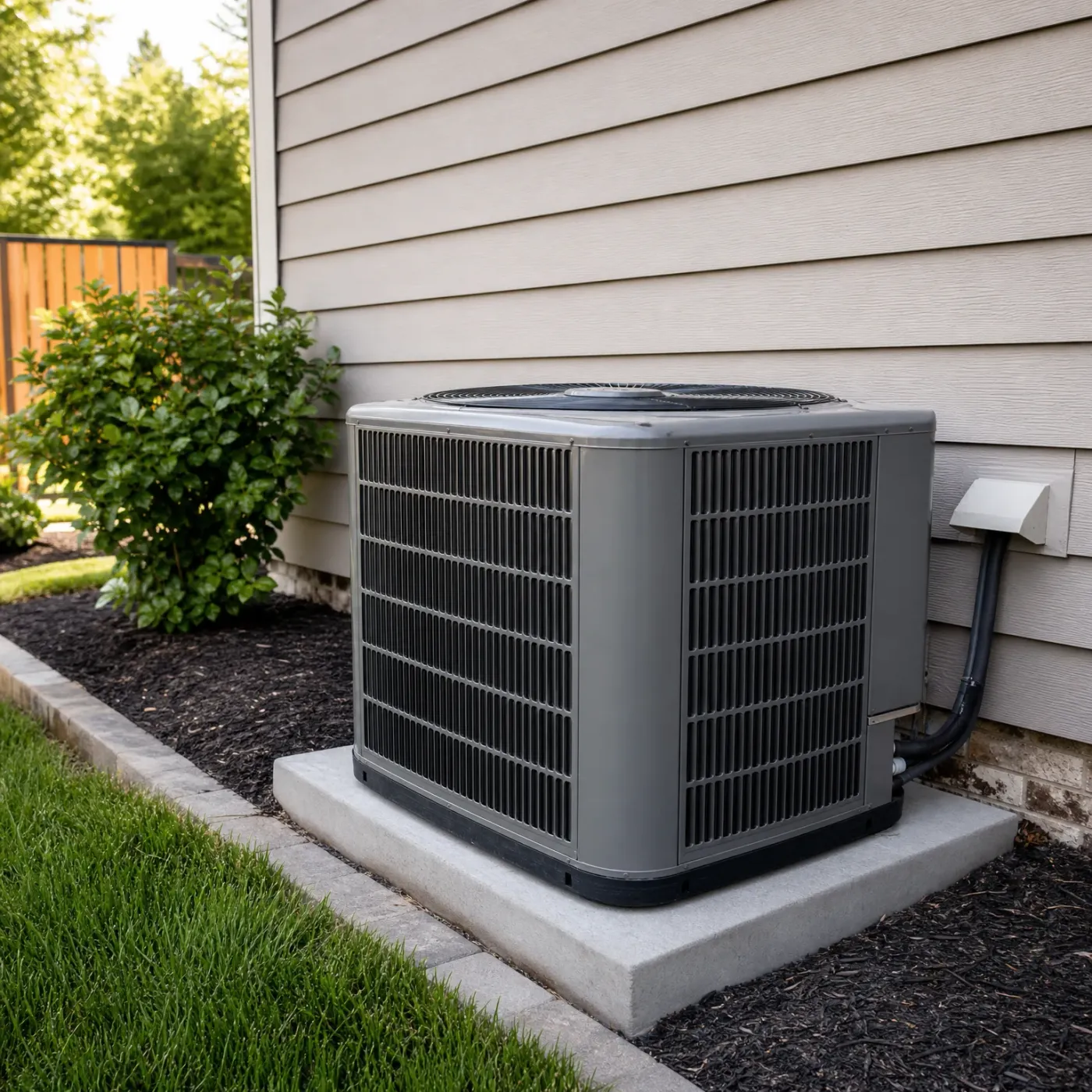
Fan spinning, unit running normal
This is what you want to see: the fan pulling air through the fins, the compressor humming along with it. If yours looks like this and runs, the breaker, capacitor, and wiring are all doing their job.
A fan that won't turn usually comes down to one of a few things: a dead capacitor, a seized motor, a tripped breaker, or wiring a squirrel or a winter's worth of moisture got into. The capacitor gives the motor its starting kick, and when it fails the motor just sits there humming or doing nothing at all. On a unit that sat idle through a Vermont winter under a cover or next to a snowbank, the motor bearings can also seize up from sitting unused for months. Check the breaker first since a simple trip is the easiest fix. If the fan hums but doesn't spin, or the whole unit is silent, the problem is inside the cabinet, not something to fix by giving it a nudge. Running the compressor without the fan moving air across the coil can overheat the system fast, so the unit needs to stay off until someone looks at it.

This is what you want to see: the fan pulling air through the fins, the compressor humming along with it. If yours looks like this and runs, the breaker, capacitor, and wiring are all doing their job.

Grime caked on the fins, a casing that's seen a few Vermont winters, lines running into the wall with no fan turning above them. That stillness means the motor isn't getting power or can't turn, and it won't start on its own.




The fan sits on top of the outdoor unit and only runs when the compressor calls for cooling, so if nothing is calling for cooling, a silent fan is normal. When it should be running and isn't, the capacitor is usually the first thing a tech checks, since a weak one can leave the motor humming instead of turning. If the motor itself has a seized bearing, power can reach the unit fine and the fan still won't move. The contactor is another common point of failure. It's the switch that sends power out to both the fan and the compressor, and when the contacts get pitted or stuck, both stop at once rather than just one. Vermont winters bring their own risk to the low-voltage wiring, since mice get into outdoor units and moisture works into connections, and a chewed or corroded wire can cut power to the fan while leaving everything else running. Before assuming the worst, it's worth confirming the thermostat is calling correctly and the breaker hasn't tripped, since neither of those involves the unit itself.


A Vermont summer doesn't run as hot as what people deal with further south, but the afternoons still get muggy enough to put real load on a struggling system. When the outdoor fan won't turn, the compressor keeps running without anything pulling air across it. That part gets hot fast, and most units are built to shut themselves down before it cooks, which is why you'll sometimes find the whole system dead instead of just the fan. If it doesn't shut down on its own, you're running a compressor under stress, and that's the expensive part of the unit to replace. Vermont's electric rates are high enough that a compressor working against no airflow shows up on the bill before you even notice the house isn't cooling right. Oil heat handles most of the state's winter heating, so a lot of homes here never have to think about ductwork or furnace wiring until something like this comes up outdoors in July. A dead capacitor, a seized motor, a tripped breaker, or wiring damage from moisture or a rodent are the usual reasons the fan sits still. None of those get better by waiting. What starts as a capacitor you could have swapped out often turns into a compressor replacement if the unit keeps running without the fan for long. Looking at the breaker and glancing at the fan blade before the hot stretch of summer hits is a cheap way to catch this before it becomes the expensive version of the same problem.
At 22.79 cents per kilowatt-hour, a stuck fan costs you twice. The compressor keeps drawing power while it strains against the heat it can't shed, and your air conditioner runs longer trying to cool the house. Getting the fan spinning again is what stops that waste.
EIA-861 2025 statewide residential average
Vermont summers don't get as heavy as other places, but the unit still has to work against real heat on the muggy days, and a fan that won't turn gives it no way to shed that heat at all. The compressor keeps running, drawing current, with nothing moving air across the coil. That's the condition that burns out a compressor in an afternoon instead of wearing it down over years. A system here might only see hard use for a handful of weeks a summer, which is exactly why one of those weeks is the wrong time to find out the fan quit.
Most Vermont homes run on oil heat, so the central air sits idle most of the year, through a hard winter, then gets asked to start up again in late spring. Wiring and connections that sat through months of cold and damp don't always come back clean. A connector that corroded over the winter, or wiring a rodent got into while the unit sat unused, can keep the fan motor from ever getting the signal to start, even with a good capacitor and a good motor behind it.


Describe what your air conditioner is doing once, in one form.
Describe your air conditioner job, and a local pro who handles it gets in touch.
Asking costs nothing, and the choice to hire stays yours.
You walk out to the outdoor unit and hear it working, a low hum, but the fan blade on top isn't moving at all. It's not silent, so it feels like it should be an easy fix, and you want to know what that hum actually means before you decide whether this is something to watch or something to call about.
The motor needs a jolt from the capacitor to get the blade turning. When the capacitor weakens, the motor gets power but not enough of a kick to start moving, so it just sits there and hums. Sometimes a gentle push on the blade with a stick will get it spinning, which confirms the capacitor is the problem. Leave it running like that and the motor keeps drawing current without doing its job, and that heat has nowhere to go. A seized bearing can cause the same hum, but it won't spin even with a push. Either way, the unit shouldn't be left running while you figure out which one it is.

This unit sits clear of dirt, with its lines and conduit running straight into the wall. A fan in this shape turns freely and moves air through the fins the way it should, cooling season after season without strain.

Dirt has built up on the grilles here, and the disconnect box on the siding is where a tech checks for power before touching anything. Grime like this makes a motor work harder, and it's often sitting on top of a capacitor or wiring problem underneath.
You walk out and the unit is either dead quiet or running with no fan blade moving on top. Sometimes there's a hum and the blade doesn't turn, sometimes nothing at all. You might notice the air coming from your vents inside has gone warm, or it's running but not keeping up the way it used to. There could be a burning smell near the outdoor cabinet, or you shut the system off at the thermostat because it didn't feel right to leave it running. If the compressor keeps trying to work without the fan clearing heat away from it, that part can take damage that turns a fan repair into a much bigger one.

A dew point of 59°F is what Vermont's summer air averages across June, July and August, measured at the places people actually live. That's mild as these things go, nothing like the thick air further south. But a fan that's stopped turning doesn't care how mild the air is. Without airflow moving across the coil, the compressor has no way to shed heat even on a comfortable July day, and it'll keep straining until something trips. You'll notice the house holding its temperature, or warm air easing out of the vents instead of cool.
NASA POWER T2MDEW county cells weighted by homes


The thermostat calls for cooling and power reaches the unit.
The capacitor sends the motor its starting jolt.
The fan motor spins the blade and pulls air through the fins.
The compressor runs while the fan carries heat away.

A silent fan or one that hums without turning points to a specific part: the capacitor, the motor, the breaker, or wiring that moisture or a squirrel got into. None of those fix themselves, and running the system while the fan sits still just stresses the compressor and burns power you're already paying a high rate for. You don't need to know which part it is before you act. You just need someone to look.
Finding that someone is usually the slow part. Searching contractors, calling around, describing the hum and the still blade over and over, then weighing quotes against each other takes time most people don't have to spare on a July afternoon. Answer a few questions about what you're seeing at the unit, and a contractor who handles this kind of repair in Vermont gets matched to your situation and reaches out to you directly. No list of names to sort through, no retelling the problem to the next person on the list.






Answer a few questions instead of calling shop after shop.
No fee to send it, and nothing to sign.