Tell us about the job
Takes about a minute. No obligation.

A contractor quoting central AC in Washington County has to establish what the system will actually be asked to do before a load calculation means anything. Homes in Washington County, VT have essentially no cooling season — no month of the year is warm enough to call for it. The compressor will sit idle season after season, and long idle periods carry their own failure modes: refrigerant seals dry out, contactors corrode, and a fault goes undiscovered until the first genuinely warm day. An installer who treats this as a standard cooling job skips the question of whether the investment is matched to the load this house actually places on it.
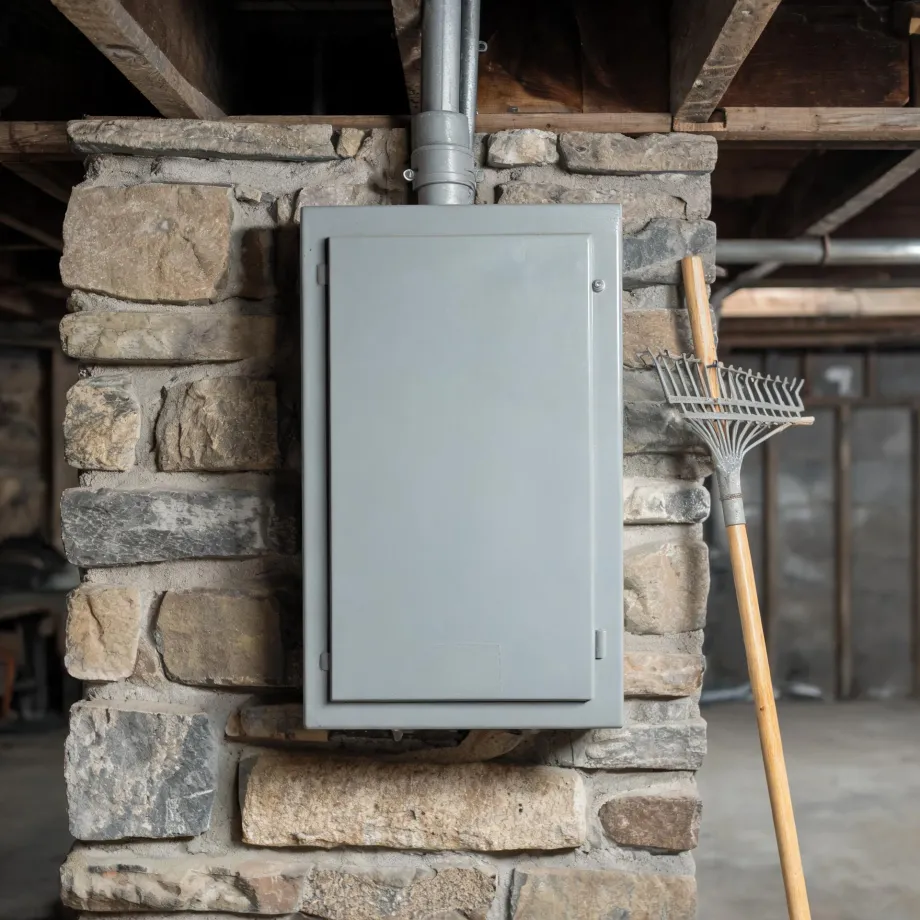
Existing ductwork is where a central AC installation either goes smoothly or gets complicated. Half the homes in Washington County, Vermont were built in 1973 or earlier (2020-2024 ACS 5-year). Houses that old were built around whatever heating equipment came first, and the duct runs, trunk sizes, and return paths reflect that original system. A contractor installing central air now has to assess whether those runs can move the volume a modern unit delivers, or whether sections need to be reworked before the new equipment ever gets charged. Electrical service gets the same look, since the original panel may not carry the additional load. The unit itself gets chosen after that picture is clear.
What a Central AC Installation Puts in Your Home
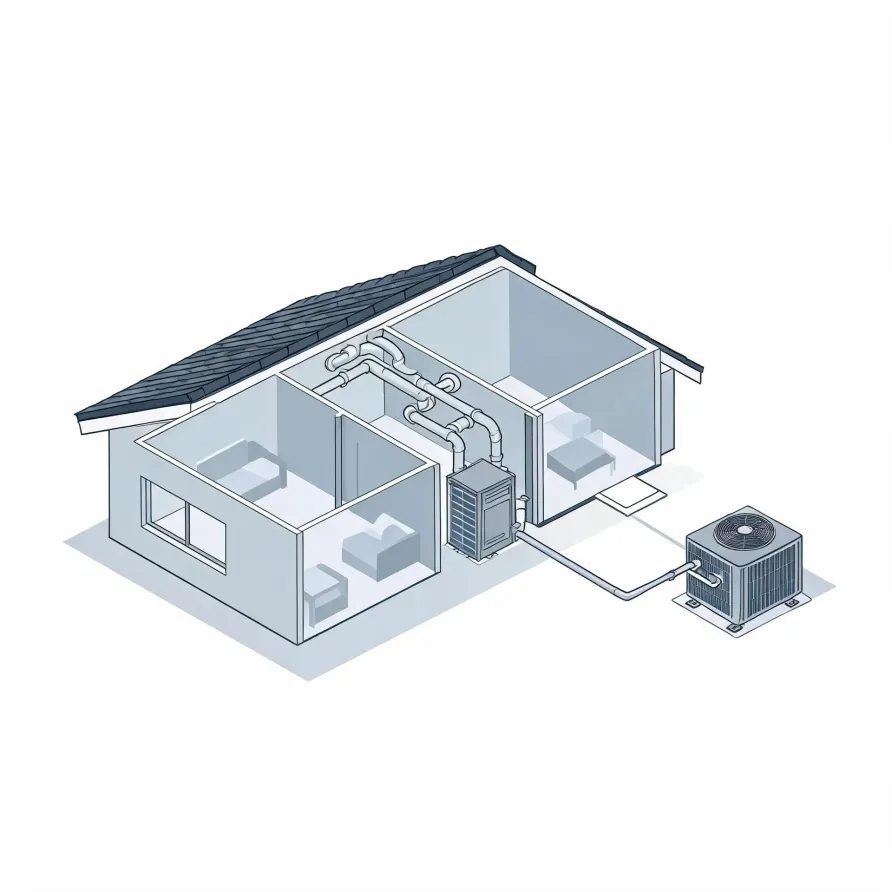
The outdoor condenser unit sits on a concrete pad beside the house and holds the compressor and condenser coil, which are the mechanical core of the system. Inside, the air handler mounts in a utility space, basement, or attic and circulates air across the evaporator coil. These are the two main pieces a contractor brings in and sets in place.
A copper refrigerant line set runs between the outdoor and indoor units, linking them through the wall or floor. A programmable thermostat goes on an interior wall where it reads the home's air and signals the system to run. The condensate drain line runs from the air handler to a floor drain or outside, carrying away the moisture the coil pulls from indoor air.
The drawing shows a typical layout, and a licensed contractor determines exactly how each piece fits the specifics of your house.
Find a contractor in Washington CountyWashington County, Vermont, by the numbers
113 severe weather events were recorded in Washington County, Vermont between 2015 and 2024.
NOAA National Centers for Environmental Information, Storm Events Database, bulk CSV export, events 2015-01-01 through 2024-12-31.Half the homes in Washington County, Vermont were built in 1973 or earlier (2020-2024 ACS 5-year).
U.S. Census Bureau, 2020-2024 American Community Survey 5-Year EstimatesWashington County, Vermont holds 31,004 housing units (2020-2024 ACS 5-year).
U.S. Census Bureau, 2020-2024 American Community Survey 5-Year EstimatesOwners occupy 73.7% of the occupied homes in Washington County, Vermont (2020-2024 ACS 5-year).
U.S. Census Bureau, 2020-2024 American Community Survey 5-Year EstimatesCodes & Standards Governing Central AC Installation in Washington County, Vermont10 sourced rules and standards
What the Installation Actually Looks Like
Split-system central air conditioners rated below 45,000 Btu/h manufactured on or after January 1, 2023 must meet a federal minimum of 13.4 SEER2.
Split-system central air conditioners rated at or above 45,000 Btu/h manufactured on or after January 1, 2023 must meet a federal minimum of 13.4 SEER2.
Split-system central air conditioners manufactured between January 1, 2015 and December 31, 2022 had to meet 13 SEER, the metric that preceded SEER2.
Single-package central air conditioners manufactured on or after January 1, 2023 must meet a federal minimum of 13.4 SEER2.
Space-constrained central air conditioners manufactured on or after January 1, 2023 must meet a federal minimum of 11.7 SEER2.
Federal efficiency standards for split-system central air conditioners and heat pumps are set on each certified combination of outdoor unit and indoor coil rather than on the outdoor unit alone.
Residential and light commercial air conditioning and heat pump systems assembled in the field, including mini-splits and unitary systems, may not be installed on or after January 1, 2025 using a refrigerant with a global warming potential above 700.
A field-assembled system whose specified components were all manufactured or imported before January 1, 2025 carries no installation compliance date under the refrigerant restrictions and may still be installed.
Licensing and Legal Requirements in Washington County, Vermont
Vermont splits the trade across two specialty licences and a contractor may hold one without the other: field A1 covers automatic gas or oil heating including geo-thermal and ground source heat pumps, and field C3 covers refrigeration or air conditioning including air-to-air heat pumps.
Vermont reaches HVAC work through its electricians’ licence rather than an HVAC licence, and the requirement stops at the front door of a house: anyone performing electrical work in Vermont must be licensed as an electrician unless the work is in a residential building containing two or fewer dwelling units.
Severe Weather Events in Washington County
Weather conditions here place real demands on heating and cooling equipment, affecting how hard a system works and how long it lasts. That load profile is local, which is why the installation choices a contractor makes in Washington County are not the same ones that make sense everywhere.
113 severe weather events, 2015–2024. Source: NOAA National Centers for Environmental Information, Storm Events Database.